LAGOS LAGOS
 |
|
|
Lagos sits along the western Algarve in southern Portugal, where the coastline becomes sculptural and irregular, defined by golden cliffs, narrow inlets, and open Atlantic exposure. The town balances a historic maritime core with some of the most visually distinctive coastal formations in the country.
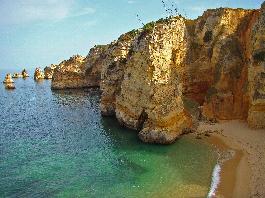
The shoreline is its defining element. Just beyond the center lies Ponta da Piedade, a headland of eroded limestone arches, sea stacks, and hidden grottoes carved by waves and wind. The rock formations drop sharply into clear, shifting water, creating a fragmented seascape of coves and channels that feels intricate and constantly changing depending on light and tide.
Beaches around Lagos are not continuous but segmented between cliffs. Among the most notable is Praia Dona Ana, where enclosed sandy pockets meet calm, transparent water, framed by steep ochre-colored rock. Each beach feels distinct, shaped by the specific geometry of the surrounding cliffs rather than by a uniform coastline.
The historic center sits slightly inland from the cliffs, enclosed by remnants of old walls and organized in a compact grid of narrow streets. Whitewashed buildings, tiled façades, and small squares create a human-scale environment that contrasts with the dramatic openness of the coast. This was once a key port during Portugal’s Age of Discoveries, and that maritime legacy still underlies the town’s identity.
The harbor and marina extend this connection to the sea into the present, with boats, promenades, and modern infrastructure linking Lagos to wider coastal routes. Despite this, the town retains a relatively contained scale, avoiding the sprawl seen in some resort areas.
What defines Lagos is the interaction between precision and erosion: a structured town set against a coastline that has been irregularly carved into complex forms. It feels both historic and elemental, where human geometry meets a landscape shaped by the Atlantic’s long, continuous force. |
|



 Greek
Greek  English